
📋 Source: ISF Annual Report FY2025-26
⏱️ 10-min read
Careers & Job Market
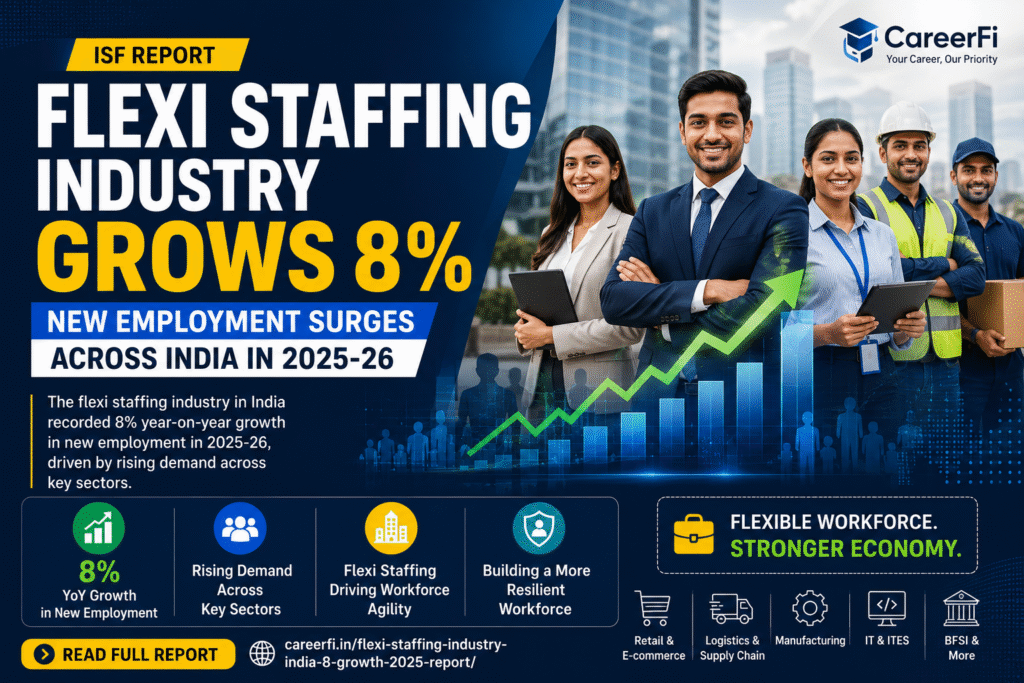
At a time when global headlines are dominated by layoffs, AI-driven job displacement, and economic uncertainty, India is quietly scripting a very different story. The country’s flexi staffing industry — one of the most important barometers of real-world employment health — has grown by 8% year-on-year in FY2025-26, adding 1.18 lakh new formal jobs to the economy, according to the latest annual report released by the Indian Staffing Federation (ISF).
This is not just a statistic for economists and HR professionals to ponder. For freshers entering the job market, for professionals considering a career switch, and for students wondering where India’s real employment opportunities lie — this report is a roadmap. It tells you which sectors are hiring, which roles are in demand, why companies are increasingly choosing flexi workers, and what the job landscape is expected to look like going into FY27.
CareerFi has dug deep into the ISF report and multiple supporting data sources to bring you the most complete, career-focused breakdown of India’s flexi staffing boom. Read on — this directly affects your next opportunity.
📋 In This Article
- What Is Flexi Staffing — and Why It Matters to You
- The Big Numbers: ISF Annual Report FY26 at a Glance
- General Staffing: 1.15 Lakh Jobs Across 5 Key Sectors
- IT Staffing Rebounds: 10.1% Growth Driven by GCCs & AI
- The Youth Factor: Over Half the New Hires Are Under 25
- What’s Driving the Growth? GST 2.0, PLI & Quick-Commerce
- Sector-by-Sector Breakdown: Where the Jobs Are
- Q4 FY26 Recovery: What the January–March Data Shows
- FY27 Outlook: Which Sectors Will Hire the Most
- The Bigger Picture: India’s ₹2.58 Lakh Crore Flexi Opportunity
- What This Means for You — Career Action Guide
- FAQs
1. What Is Flexi Staffing — and Why It Matters to You
Flexi staffing (also called contract staffing, temporary staffing, or flexi-workforce employment) refers to a model where workers are hired by companies through third-party staffing agencies, typically on a fixed-term or project-based contract. The staffing agency is the legal employer — it handles payroll, PF, ESIC, and compliance — while the worker performs duties at the client company.
For job seekers, this might sound like a compromise. But here’s the reality in 2026: flexi staffing has become a mainstream, formal employment pathway, not a fallback option. Tier-2 and Tier-3 city workers under flexi arrangements now receive recognised employment, fair pay, annual incentives, and health coverage. The model offers the speed of a private job with the security structures of formal employment.
For companies, flexi staffing offers workforce agility — the ability to scale teams up or down without the compliance burden of permanent hiring. For India’s economy as a whole, it is the most powerful engine currently moving workers from the informal to the formal sector. And for you, it is increasingly the fastest path from “student” to “employed professional.”
2. The Big Numbers: ISF Annual Report FY26 at a Glance
The Indian Staffing Federation, the apex body of the flexi staffing industry in India, released its FY2025-26 annual report in June 2026. Here are the headline findings that every job seeker and career professional should know:
3. General Staffing: 1.15 Lakh Jobs Across 5 Key Sectors
General staffing — which covers non-IT roles across blue-collar, grey-collar, and entry-to-mid level white-collar positions — delivered the bulk of FY26’s employment gains. General staffing added 1.15 lakh jobs during FY26, registering 7.9% annual growth.
The sectors that drove this surge are deeply embedded in India’s day-to-day consumption economy — the kinds of businesses that keep the country running regardless of global headwinds. FMCG, retail, consumer durables, logistics, transportation and manufacturing emerged as the key sectors driving recruitment during the year.
What makes this particularly meaningful is that many of these jobs are in Tier-2 and Tier-3 cities, democratising employment growth beyond the traditional tech-hub metros of Bangalore, Hyderabad, and Pune.
4. IT Staffing Rebounds: 10.1% Growth Driven by GCCs & AI
After a period of subdued performance caused by global tech sector headwinds, IT staffing has made a strong comeback, clocking 10.1% year-on-year growth in FY26. This is arguably the most significant signal in the entire ISF report for anyone in the tech career space.
The driving force is unmistakeable: Global Capability Centres (GCCs) — India-based R&D and operations hubs of multinational corporations — commanded 73% of all new IT staffing mandates in FY26. As per ISF Vice President Farhan Azmi, the surge was anchored heavily by GCCs commanding 73% of new mandates.
These are not low-skill data entry roles. GCC demand in FY26 was concentrated in Artificial Intelligence, Machine Learning, Cloud Computing, Cybersecurity, and Data Engineering. The report also highlighted the emergence of new recruitment categories during the second half of FY26 — AI-related roles such as prompt engineering and AI quality assurance appeared as distinct hiring categories for the first time.
However, the picture is not uniformly rosy. Hiring in traditional IT services remained subdued amid global uncertainties and cautious recruitment by large technology companies. The growth in IT staffing is concentrated in GCC-linked, AI-adjacent roles — a signal for tech professionals to upskill accordingly.
| Role Category | Demand Level | Primary Employer Type |
|---|---|---|
| AI / ML Engineering | 🔥 Very High | GCCs, Product Companies |
| Prompt Engineering | 🔥 Emerging | GCCs, AI Startups |
| Cloud Computing | 📈 High | GCCs, IT Services |
| Cybersecurity | 📈 High | GCCs, BFSI, Govt |
| Data Engineering | 📈 High | GCCs, Analytics Firms |
| Traditional IT Services | ⚠️ Subdued | Legacy IT MNCs |
5. The Youth Factor: Over Half the New Hires Are Under 25
Perhaps the most encouraging data point in the entire ISF report for our readers at CareerFi: more than half of all new formal hires in FY26 were in the 18-25 age group.
This is not a coincidence — it reflects a deliberate structural shift. India’s flexi staffing companies are actively targeting fresh graduates, diploma holders, and school-leavers in Tier-2 and Tier-3 markets who want formal employment with PF, ESIC, and health benefits. The ISF itself has highlighted that Tier-2 and Tier-3 city workers under flexi arrangements now receive recognised employment, fair pay, annual incentives, and health coverage.
For first-time job seekers, this is a powerful opportunity. Flexi staffing companies are essentially serving as a bridge — helping young people get their first formal payslip, their first PF account, and their first employer reference. This in turn makes them more employable for permanent roles down the line.
50%+
of all new flexi hires in FY26 were aged 18–25
India’s flexi staffing boom is a youth employment engine — creating the country’s largest formal entry point for first-time job seekers outside government and campus placements.
6. What’s Driving the Growth? GST 2.0, PLI & Quick-Commerce
The ISF report attributed the increase in employment to three structural factors — none of which are temporary or cyclical. These are deep, policy-driven trends that will continue to generate employment for years:
GST 2.0 — Supply Chain Formalisation
The next phase of GST compliance is driving companies to formalise their supply chains — replacing informal labour with documented, PF-enrolled, flexi-staffing workers. Every tier of the supply chain moving to formal employment means more flexi staffing demand.
PLI Investments — Manufacturing Ramp-Up
Production-Linked Incentive (PLI) schemes are bringing manufacturing to India at scale — from semiconductors to mobile phones, appliances, and solar panels. Each new PLI-linked factory creates hundreds of flexi staffing positions in production, quality control, warehousing, and logistics.
E-com & Quick-Commerce — The Last Mile Surge
Platforms like Blinkit, Zepto, Swiggy Instamart, and Meesho are creating hundreds of thousands of flexi jobs in delivery, dark store operations, customer support, and fulfilment. This segment is growing faster than any other in the country’s employment landscape.
7. Sector-by-Sector Breakdown: Where the Jobs Are in FY26
| Sector | Role Types | FY26 Status | FY27 Outlook |
|---|---|---|---|
| FMCG & Retail | Sales, Distribution, Promo Staff | Strong | 🔼 Top Driver |
| Logistics & Transport | Delivery, Warehouse, Dispatch | Strong | 🔼 Top Driver |
| IT / GCC | AI/ML, Cloud, Data, Cyber | Rebounding | 🔼 Top Driver |
| Manufacturing | Production, Quality, Assembly | Strong | ↗ Growing |
| Healthcare & Pharma | Para-medical, Lab, Admin | Steady | 🔼 Top Driver |
| E-com & Quick-Commerce | Delivery, Dark Store Ops, Support | Very Strong | 🔼 Top Driver |
| Consumer Durables | Sales, Field Technicians, Service | Steady | ↗ Growing |
8. Q4 FY26 Recovery: What the January–March 2026 Data Shows
After a brief seasonal slowdown in Q3 (October–December 2025), employment grew 0.9% quarter-on-quarter in the January–March 2026 period, signalling a clear recovery trajectory. This quarterly recovery data is significant because Q4 is typically when new hiring cycles begin — fresh graduates enter the workforce, and companies begin executing annual workforce plans.
ISF President Manmeet Singh described the sector’s performance as evidence of the “structural maturity” of India’s talent supply chains and their role in supporting the broader economy. This is an important phrase — structural maturity means the growth is not driven by a single temporary factor like a post-pandemic bounce, but by deep, embedded demand for flexible workforce solutions.
Corroborating this view, the Naukri JobSpeak March 2026 report showed India’s white-collar job market closed FY26 at +8% annual growth — the strongest job growth in three years, with fresher hiring (0-3 years experience) growing 16% year-on-year.
9. FY27 Outlook: Which Sectors Will Drive the Most Hiring
Looking ahead, ISF has identified the five sectors expected to generate the strongest demand for flexi staffing in FY27. If you are planning your career move, upskilling, or reskilling — this is the most forward-looking data available right now:
E-commerce & Quick-Commerce
India’s 10-minute delivery boom shows no signs of slowing. ISF identifies this as the single biggest source of new flexi employment in FY27, especially for youth in urban and semi-urban areas in logistics, sorting, and fulfilment roles.
#1 Priority
FMCG & Retail
India’s consumption story continues to drive massive demand for sales staff, promoters, merchandisers, and field executives — especially as FMCG companies expand deeper into Bharat.
#2 Priority
Logistics & Road Transport
The logistics sector is being turbo-charged by both e-commerce demand and the formalisation of the trucking industry under GST. Warehouse managers, logistics coordinators, supply chain analysts, and last-mile delivery experts are in high demand.
#3 Priority
Healthcare & Pharma
India’s expanding healthcare infrastructure — from Ayushman Bharat hospitals to diagnostics chains to pharmaceutical manufacturing — is generating sustained demand for paramedical staff, lab technicians, medical representatives, and hospital support roles.
#4 Priority
GCC-Led Technology Hiring
With 73% of FY26’s IT mandates coming from GCCs, this engine will only accelerate in FY27. India is now home to over 1,700 GCCs employing over 1.9 million professionals — and this number is on a steep growth curve, with AI and data roles at the centre of demand.
#5 Priority
10. The Bigger Picture: India’s ₹2.58 Lakh Crore Flexi Opportunity
Zoom out from the FY26 numbers and the scale of India’s flexi staffing story becomes truly staggering. According to an earlier ISF study, the flexi staffing industry’s revenue is projected to reach ₹2.58 lakh crore (approximately $24 billion) by FY27, growing at a compound annual growth rate of 17.3%.
The total flexi workforce is expected to reach 9.16 million workers by FY27, up from 1.91 million represented by ISF members today — a reflection of the vast informal workforce still to be formalised. India’s flexi staffing industry already accounts for 1.3% of the total national workforce, placing India among the top three flexi staffing markets globally.
For context, manpower suppliers — staffing companies — already account for nearly half of net payroll additions within the expert services category during FY26, based on EPFO payroll data. This means flexi staffing companies are now a significant contributor to India’s formal employment numbers as tracked by the government’s own data systems.
11. What This Means for You — Career Action Guide
Data is only valuable when you act on it. Here is how different career stages should interpret and respond to the ISF FY26 report:
🎓 For Fresh Graduates & Students
The flexi staffing boom is your fastest on-ramp to formal employment. Don’t wait for the “perfect permanent job” — a flexi role at a reputable company gives you PF, ESIC, work experience, and a reference. Start with FMCG, logistics, or e-commerce roles and build from there. For tech grads: get certified in cloud or AI fundamentals immediately — GCCs are hiring now.
💼 For Mid-Career Professionals
The GCC surge means that contract roles at multinational R&D centres are paying market-competitive salaries with high learning opportunities. If you are in IT, moving into a GCC-facing contract role gives you exposure to global projects, cutting-edge tools, and a network that can convert to a permanent offer. In non-IT, supply chain and logistics management are the hottest mid-career paths.
📍 For Job Seekers in Tier-2 & Tier-3 Cities
The ISF data is particularly encouraging for non-metro job seekers. Flexi staffing companies are actively expanding into smaller cities, driven by PLI-linked manufacturing, FMCG rural push, and logistics network expansion. You don’t need to move to Bangalore to access formal employment in 2026. Look for local staffing companies empanelled with major FMCG or logistics brands.
⚙️ Skills to Develop Right Now
- AI/ML basics (for tech roles)
- Supply chain & logistics (for non-tech)
- Cloud certifications (AWS/Azure/GCP)
- Healthcare support skills (B.Pharma, para-medical)
- Digital sales & field marketing (FMCG roles)
12. Frequently Asked Questions
📈 The Formal Job Market Is Growing — Are You Ready?
India added 1.18 lakh formal jobs in flexi staffing alone in FY26 — and FY27 is projected to be even bigger. The sectors are clear, the skills are known, and the opportunity is real. Don’t wait for the “perfect” job listing. Start building the skills and connections that the fastest-growing employment model in India demands. CareerFi is here to help you navigate every step.
Never Miss a Career Opportunity 🎯
CareerFi tracks every major hiring report, industry trend, internship, and job update that matters for Indian freshers and professionals. Follow us to stay ahead.
📌 Disclaimer: This article is compiled from publicly available information including the ISF Annual Report FY2025-26, BW Businessworld, IANS, Naukri JobSpeak Index, and other cited sources. All data is presented for informational and career guidance purposes. Market projections and hiring trends are subject to change. CareerFi.in is not affiliated with the Indian Staffing Federation or any staffing company mentioned. Always verify current openings through official company or staffing agency portals.