
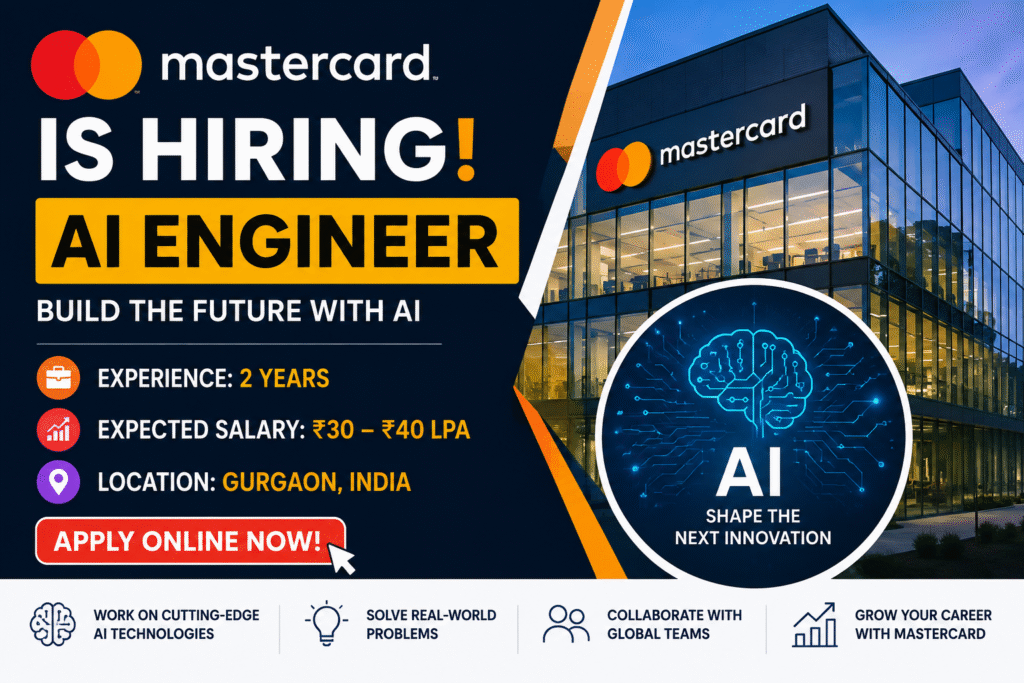
₹30 – ₹40 LPA
PUNE / VADODARA / GURUGRAM
Mastercard AI Engineer Hiring 2026: Role, Salary & Prep Guide
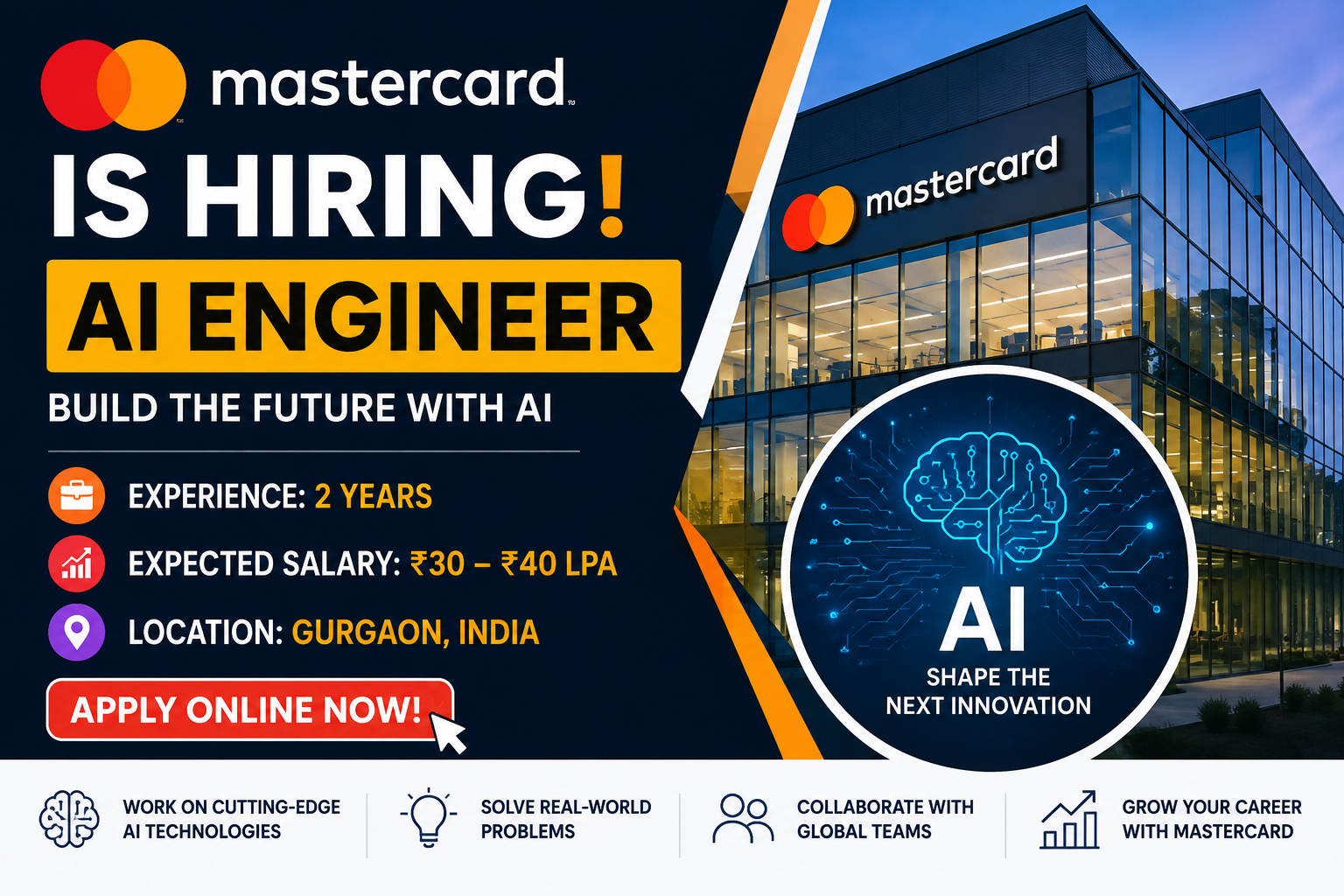
A complete, deeply technical breakdown of Mastercard’s recruitment drive for AI Engineers with 2+ years of experience. Learn about compensation, interview rounds, required skill stacks, and proven preparation strategies.
Mastercard is actively recruiting AI Engineers with 2+ years of experience in India, offering package bands between ₹30 LPA and ₹40 LPA CTC. As cross-border transactions and digital payment ecosystems integrate real-time artificial intelligence, Generative AI, and predictive fraud prevention systems, Mastercard’s Indian engineering hubs in Pune, Vadodara, and Gurugram are expanding fast. This exhaustive guide provides a full roadmap covering job requirements, interview stages, technical evaluation criteria, salary components, and direct application links for 2026 applicants.
✓
Key Takeaways for Job Seekers
- Role Profile: Applied AI Engineer focusing on enterprise LLMs, RAG pipelines, model deployment, and real-time fraud detection.
- Primary Skillset: Python, PyTorch/TensorFlow, Hugging Face, LangChain, Vector Databases (Pinecone/Chroma), MLOps, AWS/Azure, REST/gRPC APIs.
- Salary Structure: Base component of ₹22–28 LPA, variable bonuses of ₹3–5 LPA, plus annual equity grants (RSUs) worth ₹4–7 LPA.
- Evaluation Focus: System design for low-latency machine learning pipelines, production coding, and understanding transformer internals.
- Hiring Hubs: Key tech centres in Pune, Vadodara, and Gurugram with flexible hybrid arrangements.
Table of Contents
1. Overview of Mastercard AI Engineer Recruitment 2026
Mastercard is one of the world’s premier payment technology networks, processing over 125 billion transactions annually across more than 210 countries and territories. In recent years, payment networks have evolved far beyond simple message routing. Modern transaction engines rely on high-throughput, millisecond-latency Machine Learning models to score risk, prevent fraudulent card authorizations, optimize merchant routing, and deliver custom consumer rewards.
The Mastercard AI Engineer role is positioned within the company’s global technology and innovation organization in India. The division focuses on building scalable enterprise solutions leveraging Machine Learning (ML), Natural Language Processing (NLP), Large Language Models (LLMs), and Computer Vision. As generative AI transforms the financial technology sector, Mastercard is scaling up its software engineering teams to embed conversational assistants, predictive analytics, and automated decision-making engines directly into its global infrastructure.
Engineers hired under this requisition (Job ID: MASRUSR287145EXTERNALENUS) will collaborate with cross-functional global teams spanning North America, Europe, and Asia-Pacific. For early-to-mid-career engineers with 2 to 4 years of hands-on software development and applied machine learning experience, this role offers an ideal balance of enterprise stability, high engineering scale, and top-tier market compensation.
2. Salary Package & Compensation Breakdown (₹30 – ₹40 LPA)
Compensation for an AI Engineer at Mastercard in India for candidates with roughly 2 years of relevant experience typically falls into the bracket of ₹30,000,000 to ₹40,000,000 per annum (₹30 to ₹40 LPA CTC). Pay packages vary based on candidate performance during technical evaluations, prior engineering credentials, and academic background.
Below is the typical component break-up for this role in major Indian hubs like Pune, Vadodara, and Gurugram:
In addition to fixed and variable pay, Mastercard offers extensive employee perks including premium comprehensive medical insurance for families, annual learning and upskilling stipends (up to $2,000 USD for industry certifications), internet and wellness allowances, and flexible hybrid work schedules (typically 2-3 days work-from-home per week).
“At payment networks operating at global scale, an AI Engineer isn’t just training models in notebooks—they are building resilient, ultra-low latency software services that safeguard real money for billions of people.”
3. Key Responsibilities & Daily Workflow
As an AI Engineer at Mastercard, your role spans software engineering, machine learning development, and distributed infrastructure management. Unlike pure Data Scientist positions that focus primarily on offline experimentation and statistical modeling, an AI Engineer owns the deployment, optimization, and lifecycle of AI models running live in production.
Primary Core Duties:
- Building Production AI & LLM Pipelines: Design, build, and maintain production-grade GenAI microservices, Retrieval-Augmented Generation (RAG) applications, and natural language interfaces for financial enterprise tools.
- Real-Time Fraud & Anomaly Detection: Integrate machine learning models into live payment decision channels requiring end-to-end response times of under 50 milliseconds.
- Model Optimization & Quantization: Fine-tune open-source models (such as Llama 3, Mistral, and Qwen) using PEFT/LoRA techniques and optimize inference speeds using TensorRT-LLM, ONNX Runtime, or vLLM.
- MLOps & Lifecycle Management: Implement automated continuous integration and continuous deployment (CI/CD) pipelines for ML models using tools like MLflow, Kubeflow, Docker, and Kubernetes.
- Data Pipelines & Vector Databases: Collaborate with data engineering teams to construct continuous data pipelines, compute feature stores, and implement high-efficiency vector databases (Chroma, FAISS, Pinecone, or Qdrant) for fast similarity searches.
- Responsible AI & Governance: Ensure every deployed model adheres to strict global data privacy regulations (GDPR, PCI-DSS, India’s DPDP Act) and passes automated security checks for prompt injection, bias, and data drift.
4. Eligibility Criteria & Educational Prerequisites
Mastercard maintains a rigorous hiring standard to ensure incoming engineers have both solid theoretical foundations and practical execution capabilities.
Education & Background
- B.E. / B.Tech / M.E. / M.Tech in Computer Science, AI/ML, Data Science, Electrical Engineering, or related quantitative fields.
- Minimum 60% or 6.5+ CGPA throughout academic degrees.
- Graduates from premier institutes (IITs, NITs, IIITs, BITS, Top State Universities) preferred but not strictly mandatory.
Work Experience
- At least 2 years of full-time professional experience as a Software Engineer, Machine Learning Engineer, or AI Developer.
- Proven track record of shipping production ML or LLM applications (not just personal or academic projects).
- Experience working in Agile/Scrum product engineering teams.
5. Core Technical Skills & AI Stack Required
To clear Mastercard’s technical filters, candidates must demonstrate proficiency across five core pillars of modern AI software development:
6. Selection Process & Interview Stages
Mastercard’s technical hiring funnel for AI Engineers spans approximately 3 to 5 weeks from initial shortlisting to final offer letter release. Here is the step-by-step breakdown:
Stage 1: Profile Shortlisting & HR Screener (15–20 Mins)
Initial resume vetting by technical recruiters to check work history, hands-on experience with LLMs/ML, and basic alignment on salary expectations, location preferences, and notice period (typically 30–90 days).
Stage 2: Online Technical Coding & ML Assessment (90 Mins)
Hosted on platforms like HackerRank or Codility. Features 2 Data Structures & Algorithms coding challenges in Python, plus 10–15 multiple-choice technical questions on machine learning theory, statistics, and PyTorch syntax.
Stage 3: Technical Round 1 – Coding, ML & GenAI Deep Dive (60 Mins)
One-on-one live interview with a Senior AI Engineer or ML Tech Lead. Focuses on live Python coding (data manipulation, custom PyTorch neural network layer creation) and deep-dive technical questions regarding your past machine learning projects.
Stage 4: Technical Round 2 – AI System Design & MLOps (60 Mins)
Whiteboard / architectural session evaluating end-to-end system design. You will be asked to design an enterprise AI system (e.g., real-time transaction fraud classifier or low-latency enterprise retrieval assistant) considering latency budgets, scaling, model inference, and vector search strategies.
Stage 5: Engineering Managerial & Behavioral Round (45 Mins)
Interview with an Engineering Director or Senior Director. Assesses cultural alignment with Mastercard’s core values (Decency, Trust, Innovation), cross-functional teamwork, handling conflicting priorities, and ethical AI perspectives.
7. Round-by-Round Interview Preparation Guide
To excel in Mastercard’s AI Engineer interview process, organize your study regimen into distinct preparation modules:
A. Data Structures, Algorithms & Python Coding
Mastercard requires clean, production-grade Python code. Practice LeetCode Medium problem patterns with a strong emphasis on:
- Arrays, Two-Pointers, and Sliding Window techniques.
- Hash Maps and Hash Sets for fast O(1) lookups.
- Binary Search, Tree Traversals (BFS/DFS), and Graph algorithms.
- Matrix manipulation and efficient vector Operations in NumPy.
B. Machine Learning Mechanics & Applied AI Fundamentals
Be prepared to explain foundational concepts without relying on high-level libraries:
- Loss Functions & Optimization: Cross-entropy, MSE, Focal Loss for imbalanced data, Adam vs AdamW optimizers.
- Handling Data Imbalance: Synthetic oversampling (SMOTE), focal loss, cost-sensitive learning for payment fraud datasets.
- Evaluation Metrics: ROC-AUC, Precision-Recall curves, F1-Score, BLEU, ROUGE, and cosine similarity metrics.
- Transformer Architecture: Scaled dot-product self-attention mechanisms, multi-head attention, positional encodings, and KV-caching.
C. Sample Technical & System Design Questions
Actual & Model Interview Prompts:
- “How would you design an end-to-end RAG architecture that allows 50,000 corporate agents to query 10 million internal PDF documents securely?”
- “If a transaction fraud model suffers from high false positive rates during holiday sales surges, how do you debug and adapt the model without causing service downtime?”
- “Write a Python function to compute cosine similarity across an array of 100,000 vector embeddings without using external libraries like Scikit-Learn.”
- “Explain the key architectural differences between BERT, GPT-4, and Llama 3. When would you select a fine-tuned encoder model over a decoder-only LLM?”
8. Mastercard vs Other Top Tech & FinTech Employers in India
How does an AI Engineering offer from Mastercard compare against other major employers in India for someone with 2 years of experience? Here is a comparative overview:
9. How to Apply Step-by-Step for Mastercard AI Hiring
Follow this structured application process to maximize your resume callback rate:
- Official Portal Submission: Visit the official Mastercard Careers post for Job Req ID: MASRUSR287145EXTERNALENUS via the direct link:
Apply Directly on Mastercard Careers. - Optimize Resume Keywords: Ensure your resume explicitly contains keywords such as Python, PyTorch, Transformers, RAG, Vector Databases, MLOps, AWS, Docker, Kubernetes, Microservices.
- Leverage Employee Referrals: Reach out to current Mastercard Senior Software Engineers or Tech Leads on LinkedIn in India. An internal referral can significantly increase shortlisting speed.
- Highlight Metric-Driven Outcomes: Describe past project experience using clear impact metrics (e.g., “Reduced API inference latency by 35% through model quantization using ONNX Runtime”).
10. Common Mistakes to Avoid on Resume & Interviews
✕
5 Critical Mistakes That Can Disqualify Applicants
- Listing Only Wrapper Frameworks: Relying exclusively on high-level APIs like LangChain without understanding core PyTorch, model architectures, or tokenization mechanics.
- Ignoring Basic Software Engineering: Writing unoptimized Python code, missing edge-case handling, or failing to implement proper error logging and modular design.
- Neglecting Latency and Scale Constraints: Designing AI systems that work well on small local datasets but fail under high enterprise request volumes (e.g., thousands of requests per second).
- Overlooking Model Monitoring: Failing to address how you will detect model drift, data hallucinations, and security vulnerabilities after deployment.
- Vague Impact Statements on Resume: Writing generic job duties instead of highlighting measurable, metric-backed accomplishments.
11. Career Growth & Upskilling Path at Mastercard
Joining Mastercard as an AI Engineer with 2+ years of experience puts you on a well-defined professional growth trajectory:
12. Frequently Asked Questions (FAQs)
Q1: Is 2 years of experience strictly mandatory for the Mastercard AI Engineer role?
While 2 years of relevant professional experience is preferred, candidates with 1.5+ years of strong experience in production ML engineering, advanced software development, or a relevant Master’s degree (M.Tech/MS in AI/CS) with impactful internship projects are also considered.
Q2: What is the expected salary range for an AI Engineer with 2 years of experience at Mastercard India?
The total package (CTC) ranges between ₹30 LPA and ₹40 LPA. This includes a base salary of ₹22–28 LPA, annual variable performance bonus of ₹3–5 LPA, and long-term equity grants (RSUs) valued at ₹4–7 LPA.
Q3: Which Mastercard India offices are hiring for this position?
The primary hiring technology centers for this role are located in Pune, Vadodara, and Gurugram (Delhi NCR). Mastercard operates under a hybrid work model allowing employees to balance office days with remote work.
Q4: How does an AI Engineer role differ from a Data Scientist role at Mastercard?
Data Scientists focus primarily on statistical analysis, data exploration, feature extraction, and offline model prototyping. AI Engineers focus on software engineering, API development, LLM integration, MLOps, vector search indexing, and deploying scalable inference pipelines into real-time production environments.
Q5: What programming languages and frameworks are most tested in the interview?
Python is the primary programming language evaluated. Key frameworks tested include PyTorch, Hugging Face Transformers, Fast/Flask API, SQL, Docker, and vector database systems (Pinecone/Chroma).
Q6: What is the notice period requirement for joining Mastercard India?
Mastercard standard practice accommodates typical Indian notice periods (30 to 90 days). Candidates with shorter notice periods (30 days or serving notice) are often prioritized for faster onboarding.
Q7: Can remote candidates from other cities in India apply?
Yes, candidates living anywhere in India can apply. However, if selected, you will be expected to align with one of the primary tech hubs (Pune, Vadodara, or Gurugram) under Mastercard’s hybrid work policy. Relocation support is provided.
Q8: What is the best way to stand out during the resume shortlisting phase?
Highlight production-grade AI engineering experience on your resume. Showcase measurable project outcomes, such as reduced API latency, cost optimizations in model inference, deployment of custom RAG pipelines, or scaled data ingestion systems.
13. Conclusion & Final Action Plan
The Mastercard AI Engineer recruitment drive for 2026 represents a high-impact opportunity for mid-level engineers looking to build scalable financial AI solutions while earning market-leading compensation (₹30–40 LPA). By combining strong foundational Python coding skills with a clear understanding of modern GenAI, RAG architectures, and low-latency system design, you can stand out in the recruitment pipeline.
Prepare your resume, review fundamental data structures and transformer mechanics, and submit your application through official channels promptly before application windows close.
Stay Ahead with CareerFi
Get real-time alerts on premium tech openings, high-paying salary breakdowns, interview prep guides, and referral opportunities across top Indian product companies.