
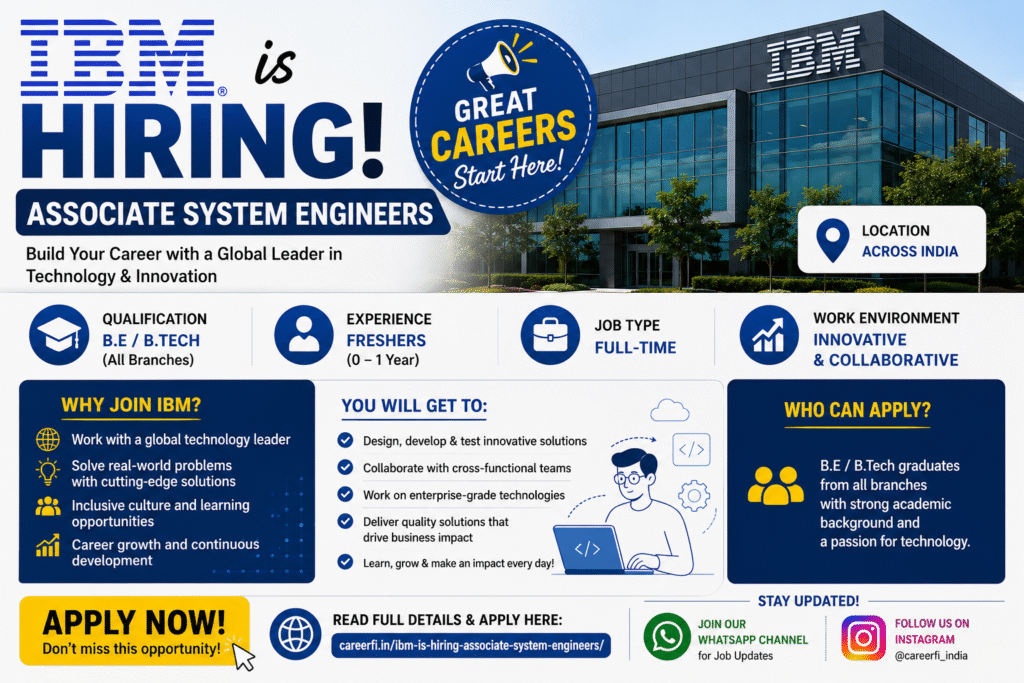

Is your code ready to shape the future? If you’re a recent tech graduate, this might be the most important article you read all year. As of Thursday, May 21, 2026, tech giant IBM has officially rolled out a massive recruitment drive for the role of Associate System Engineer, specifically targeting the bright minds from the 2024 and 2025 graduating batches.
This isn’t just another job opening; it’s a launchpad. It’s a chance to start your career with a global titan, a company synonymous with innovation, from chess-playing supercomputers to the frontiers of quantum computing. If you’ve been dreaming of turning your degree into a high-impact career, your moment has arrived. Let’s dive deep into everything you need to know to seize this incredible opportunity.
🚀 The Golden Opportunity: IBM Hiring Freshers!
IBM is on the lookout for passionate problem-solvers and tech enthusiasts to join their ranks. This drive is a significant move, signaling a strong demand for fresh talent to fuel their next wave of projects. For graduates of the 2024 and 2025 classes, this is a golden ticket to bypass the ‘experience required’ barrier and step directly into a meaningful corporate role.
Here’s a quick look at the core details of this massive hiring initiative:
| Detail | Information |
|---|---|
| Role Title | Associate System Engineer |
| Company | IBM (International Business Machines Corporation) |
| Eligible Batches | 2024 & 2025 Graduates |
| Required Qualifications | BE/BTech, ME/MTech, MCA, MSc (CS/IT & related fields) |
| Location | Across India (Flexible) |
| Experience | Entry-Level / Fresher |
| Application Link | Link to Apply |
🤔 What is an Associate System Engineer at IBM?
The title “Associate System Engineer” might sound grand, but what does it actually entail? Forget the idea of just being a coder in a cubicle. At IBM, this role is your gateway to becoming a versatile technologist.
As an Associate System Engineer, you are at the heart of building, managing, and optimizing the technology solutions that power global businesses. You are a problem-solver first and foremost.
Your daily life could involve:
- Developing and Testing Solutions: Writing clean, efficient code in languages like Java, Python, or Node.js to build software applications that solve real-world client problems.
- Understanding the Big Picture: Working with the Software Development Life Cycle (SDLC) to see projects through from concept and design to deployment and maintenance.
- Collaborating with Global Teams: Interacting with project managers, senior engineers, and clients to understand requirements and deliver top-notch technical solutions.
- Embracing Innovation: Getting hands-on experience with cutting-edge domains like Cloud Computing, AI/ML, Cybersecurity, and IoT, depending on your project allocation.
Essentially, you are a crucial link in the chain that keeps IBM’s technology engine running smoothly. It’s a dynamic role designed to foster rapid learning and growth.
💼 Why Start Your Tech Career with IBM?
Choosing your first company is a monumental decision. It sets the tone for your entire professional journey. So, why should IBM be at the top of your list?
A Legacy of Innovation: IBM isn’t just a company; it’s an institution. For over a century, it has been at the forefront of technological breakthroughs. Working here means you’re part of that legacy, contributing to technology that matters.
Unparalleled Learning & Development: IBM invests heavily in its people. You’ll have access to world-class training modules, certifications, and mentorship programs. They don’t just hire you for what you know; they hire you for what you can become.
Global Exposure: As a multinational corporation, IBM offers the chance to work on projects for clients across different industries and geographies. This provides a breadth of experience that is hard to match elsewhere.
A Culture of ‘Thinkers’: IBMers are encouraged to think, question, and innovate. It’s a culture that values intellectual curiosity and empowers you to voice your ideas, even as a fresher.
📋 Eligibility Criteria Decoded: Do You Qualify?
Before you get too excited, let’s make sure you tick all the boxes. IBM has laid out specific criteria to ensure they find the right candidates. Here’s the breakdown:
- Academic Qualifications: You must have a degree in BE/BTech, ME/MTech, MCA, or MSc. The specialization is key—they are looking for candidates from Computer Science (CS), Information Technology (IT), and related streams like Artificial Intelligence (AI/ML), Data Science, Cloud Computing, Cybersecurity, etc.
- Eligible Batches: This drive is exclusively for students who graduated in 2024 or will graduate in 2025. Your degree must be completed before you join the company.
- Academic Performance: A minimum of 60% or 6 CGPA across your education is required. Consistency matters.
- Backlog Status: You must have no active backlogs at the time of application. All your papers should be cleared.
- Flexibility: The role requires you to be flexible to work from any IBM location in India, reflecting the dynamic nature of their project needs.
💡 Detailed Analysis: In-Demand Skills for the Role
Meeting the eligibility is the first step. To truly stand out, you need to showcase the right blend of technical and soft skills. IBM is looking for well-rounded individuals, not just coding machines. Let’s analyze what they’re prioritizing.
Your technical foundation is paramount. Knowledge in at least one modern programming language is non-negotiable. But it’s your understanding of concepts and your ability to communicate that will set you apart.
| Skill Category | Key Topics to Master | Why It’s Important for IBM | Preparation Tip |
|---|---|---|---|
| Programming Proficiency | Java, Python, C++, or Node.js. Focus on OOPs, data structures, and algorithms. | These are the workhorse languages for building robust enterprise applications that IBM delivers to its clients. | Solve problems daily on platforms like LeetCode or HackerRank. Build a small personal project. |
| Conceptual Knowledge | Software Development Life Cycle (SDLC) – Agile, Waterfall. Basics of OS, DBMS, Networking. | IBM manages large, complex projects. Understanding the process (SDLC) is as crucial as writing the code itself. | Read blogs and watch videos explaining SDLC phases. Be ready to explain a project you did using this framework. |
| Problem-Solving Acumen | Logical reasoning, analytical thinking, breaking down complex problems. | As an engineer, your core job is to solve problems, whether it’s a bug in the code or a complex client requirement. | Practice puzzles, aptitude questions, and algorithmic challenges. Think out loud during mock interviews. |
| Communication Skills | Clear verbal and written expression. Ability to explain technical concepts to non-technical people. | You’ll work in diverse teams and interact with clients. Clarity and confidence are essential for collaboration. | Practice explaining a technical project to a friend from a non-tech background. Record yourself and improve. |
📝 Step-by-Step Guide to Ace Your IBM Application
Feeling confident? Great! Now, let’s channel that energy into a flawless application strategy. Follow these steps to maximize your chances of getting hired.
Step 1: The Perfect Resume
Your resume is your first impression. Tailor it for this specific role. Use keywords from the job description like “Associate System Engineer,” “Java,” “Python,” “SDLC,” and “problem-solving.” Use a clean, professional one-page format. Highlight your projects, internships, and any technical certifications.
Step 2: The Application Process
Navigate to the official IBM application portal. Fill out every detail with precision. Double-check for typos. Be honest about your skills and scores. A rushed, careless application is an easy rejection.
Step 3: Prepare for the Online Assessment
Typically, the first hurdle after screening is an online test. This usually includes sections on cognitive ability (logical reasoning, quantitative aptitude), an English language test, and a coding assessment. Practice is key. Dedicate time to solving sample papers and coding challenges.
Step 4: Nail the Technical Interview
If you clear the assessment, you’ll face one or more technical interviews. Expect deep dives into your mentioned skills. Be prepared to write code on the spot, explain your projects in detail, and answer questions on core CS fundamentals (Data Structures, Algorithms, OS, DBMS). For more professional insights and interview tips, follow us on LinkedIn for regular updates.
Step 5: Shine in the HR Interview
The final round is often with HR. This is to assess your personality, your cultural fit, and your long-term goals. Be ready to answer questions like “Why IBM?”, “Where do you see yourself in 5 years?”, and behavioral questions using the STAR (Situation, Task, Action, Result) method.
🌐 Latest Update & News Insight (May 21, 2026)
This hiring announcement on May 21, 2026, is a significant event in the current IT job market. For 2024 and 2025 graduates, who have faced a competitive landscape, this focused drive from a top-tier company like IBM is a powerful signal of industry demand for foundational tech talent. It underscores the value of strong fundamentals in programming and system design. This opportunity allows recent graduates to align their careers with a stable, innovative leader, setting them on a path of continuous learning and growth right from the start.
📣 Stay Connected with CareerFI
Want to stay ahead in your job search? CareerFI is your one-stop destination for the latest opportunities, insider tips, and career guidance. Don’t miss out!
- Get Instant Job Alerts: Join our WhatsApp channel for the fastest updates on hiring drives like this one.
- Build Your Professional Network: Follow our LinkedIn page for industry insights, interview strategies, and corporate news.
- Daily Career Tips & Motivation: Catch our daily tips and success stories on Instagram to keep your motivation high!
❓ Frequently Asked Questions (FAQs)
1. What is the expected salary for an Associate System Engineer at IBM in India?
While IBM doesn’t disclose the salary officially in the job description, the average salary for an entry-level System Engineer at IBM in India typically ranges from ₹4.5 LPA to ₹6.5 LPA, depending on various factors like performance in interviews and location.
2. Is there any service bond or agreement?
Most large IT companies in India do not have a traditional service bond. However, there might be clauses related to recovering training costs if an employee leaves within a specific period (usually 1-2 years). Always read the offer letter carefully for such details.
3. The job says ‘work from anywhere in India’. What does this mean?
This indicates that you could be assigned to a project based in any of IBM’s major offices in India, such as Bengaluru, Hyderabad, Chennai, Pune, or Gurugram. It requires you to be mobile and ready to relocate based on business requirements.
4. I am from an Electronics and Communication (ECE) background. Can I apply?
The description mentions “CS/IT and related specializations.” If your ECE curriculum had a strong focus on programming, data structures, and computer science fundamentals, you can definitely apply. Emphasize these skills in your resume.
5. I graduated in 2023. Am I eligible for this drive?
Unfortunately, this specific recruitment drive is explicitly for the 2024 and 2025 graduating batches. Keep an eye on CareerFI.in for other opportunities that match your profile.
This is more than a job application; it’s a bid for a career that could define your future. IBM is offering a platform to build, innovate, and grow. The question is, are you ready to answer the call? Polish your skills, perfect your resume, and click that apply button with confidence. Your journey as a ‘Thinker’ could be just one click away.