
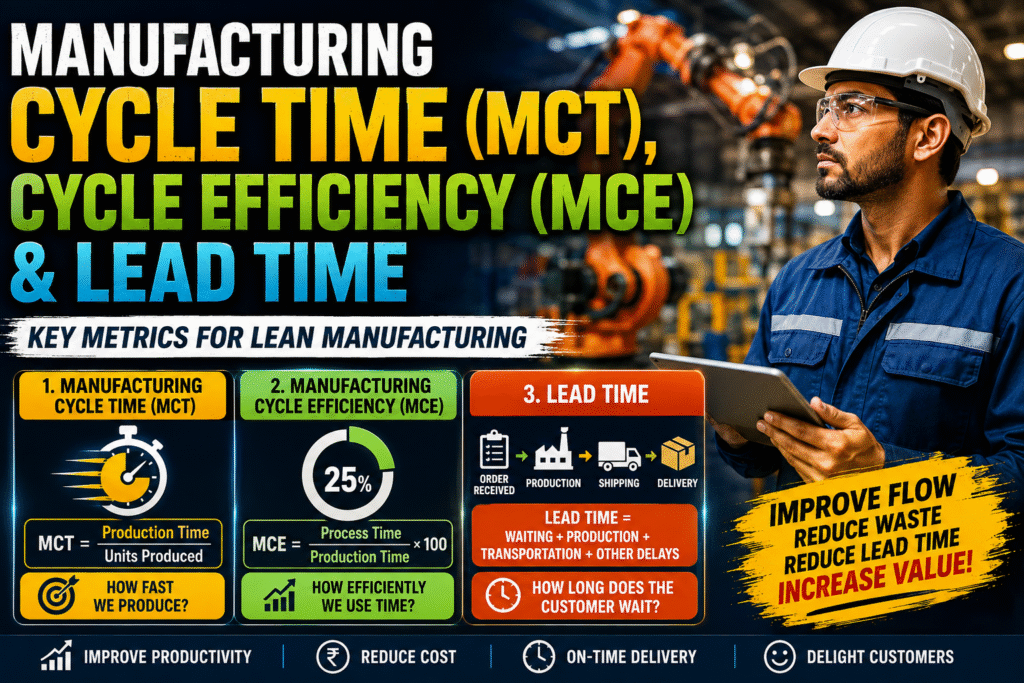
Manufacturing Cycle Time (MCT), Manufacturing Cycle Efficiency (MCE) & Lead Time Explained
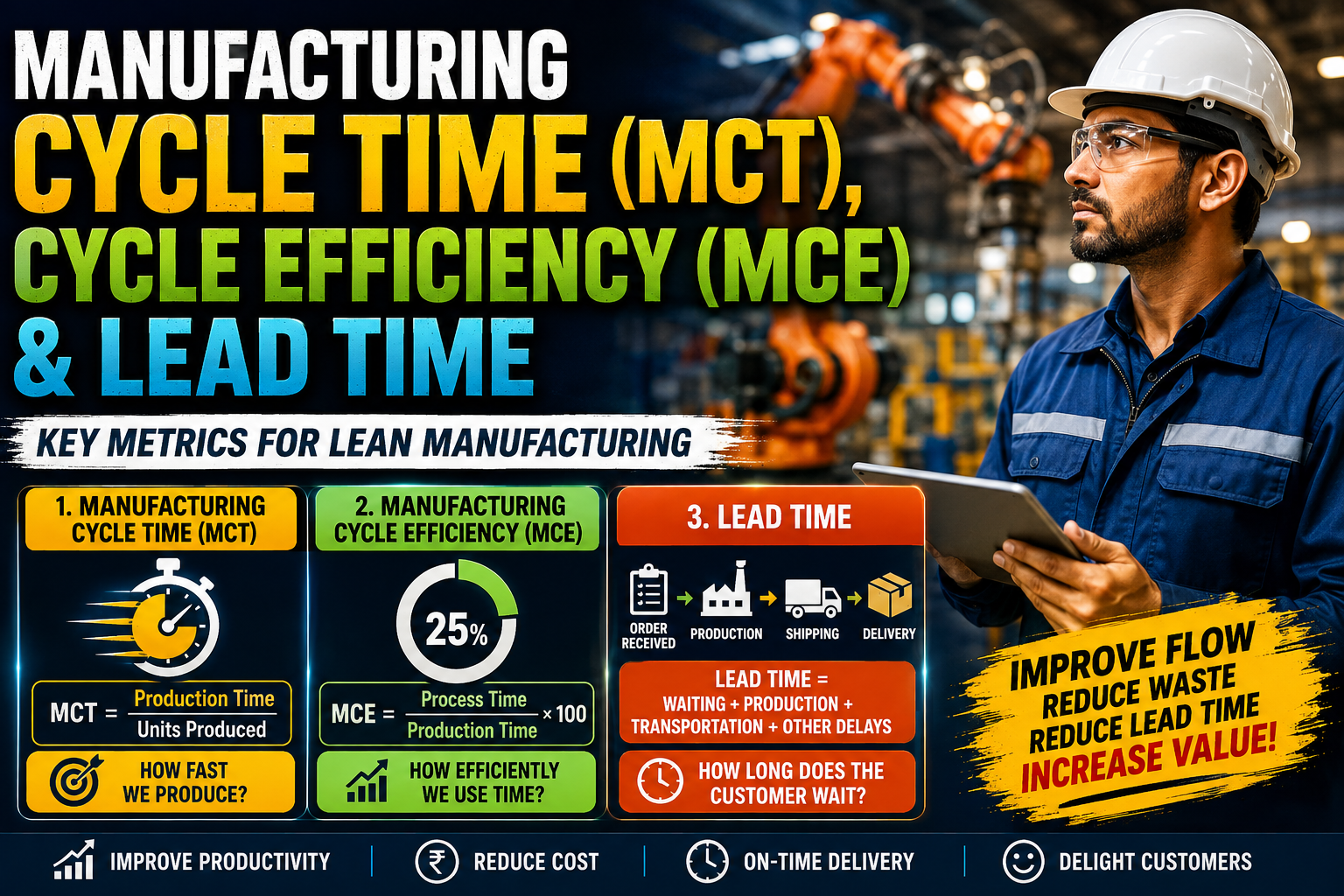
In today’s competitive manufacturing environment, organizations continuously strive to improve productivity, reduce waste, and deliver products faster. Three important Lean Manufacturing metrics help measure operational performance:
- Manufacturing Cycle Time (MCT)
- Manufacturing Cycle Efficiency (MCE)
- Lead Time
These metrics provide valuable insights into production efficiency, process performance, and customer satisfaction.
What is Manufacturing Cycle Time (MCT)?
Manufacturing Cycle Time measures the average time required to manufacture one unit of product.
Example
| Production Time | 480 Minutes |
|---|---|
| Units Produced | 240 |
| MCT | 480 ÷ 240 = 2 Minutes per Unit |
Interpretation
Every product requires an average of 2 minutes to manufacture.
Why MCT is Important
- Measures production speed
- Helps improve productivity
- Identifies process bottlenecks
- Supports production planning
- Improves capacity utilization
What is Manufacturing Cycle Efficiency (MCE)?
Manufacturing Cycle Efficiency measures how much of the total production time actually creates value for the customer.
Example
| Process Time | 120 Minutes |
|---|---|
| Production Time | 480 Minutes |
| MCE | (120 ÷ 480) ×100 = 25% |
Interpretation
Only 25% of the production time actually adds value.
The remaining 75% is Non-Value Added Time.
Sources of Non-Value Added Time
- Waiting
- Material Movement
- Transportation
- Machine Changeovers
- Queue Time
- Inspection
- Material Handling
- Machine Breakdowns
- Rework
- Delays
What is Lead Time?
Lead Time represents the total elapsed time from receiving a customer order until the finished product reaches the customer.
Lead Time Flow
Customer Order
↓
Waiting
↓
Production
↓
Inspection
↓
Transportation
↓
Delivery
Difference Between MCT, MCE and Lead Time
| Metric | Measures | Main Objective |
|---|---|---|
| Manufacturing Cycle Time | Production Time per Unit | Produce Faster |
| Manufacturing Cycle Efficiency | Value Added Time | Reduce Waste |
| Lead Time | Total Customer Waiting Time | Deliver Faster |
Lean Manufacturing Perspective
Don’t Ask
❌ How fast is our machine running?
Instead Ask
✅ How much of the customer’s lead time actually adds value?
How to Improve Manufacturing Cycle Time
- Reduce machine downtime
- Implement TPM
- Standardize work
- Reduce setup time using SMED
- Improve line balancing
- Implement Kaizen
- Remove bottlenecks
How to Improve Manufacturing Cycle Efficiency
- Reduce waiting
- Reduce transportation
- Reduce inventory
- Improve material flow
- Minimize inspections
- Eliminate waste
- Increase value-added activities
How to Reduce Lead Time
- Improve production scheduling
- Optimize logistics
- Reduce changeover time
- Improve supplier coordination
- Reduce Work in Process (WIP)
- Improve workflow
Key Takeaways
MCT → How fast do we produce?
MCE → How efficiently do we use production time?
Lead Time → How long does the customer wait?
Improve Flow
↓
Reduce Waiting
↓
Reduce Lead Time
↓
Increase Customer Value
Frequently Asked Questions (FAQs)
What is Manufacturing Cycle Time?
It is the average time required to manufacture one product.
What is Manufacturing Cycle Efficiency?
It measures the percentage of production time that actually adds value.
What is Lead Time?
Lead Time is the total time from receiving a customer order until delivery.
Why are these metrics important?
They help improve productivity, eliminate waste, reduce costs, and increase customer satisfaction.
CareerFi Manufacturing Insight: World-class manufacturers don’t just focus on producing faster—they focus on producing smarter. By continuously monitoring Manufacturing Cycle Time, Manufacturing Cycle Efficiency, and Lead Time, organizations can eliminate waste, optimize production flow, and create greater value for customers through Lean Manufacturing.