
CareerFi GuideFreshers 2026TCS Recruitment
TCS Hiring Process Explained in 2026: Complete Guide to Assessment Rounds, Interviews, and Offer Process
Understand how TCS shortlists candidates, what happens in each recruitment round, and how freshers can prepare confidently for assessments, interviews, document verification, and final onboarding.
Introduction
Every year, Tata Consultancy Services (TCS) recruits thousands of fresh graduates from engineering colleges, universities, and off-campus hiring programs across India. As one of the largest IT recruiters in the country, TCS offers excellent opportunities for students looking to begin their careers in technology, consulting, business operations, and digital transformation.
However, one of the most common questions students ask is:
Many candidates know about TCS NQT or campus placements, but they are often unsure about what happens after submitting an application. What rounds are conducted? What kind of questions are asked? How difficult are the interviews? How long does it take to receive an offer letter?
In this comprehensive guide, we will break down the entire TCS recruitment journey step by step. Whether you are applying through campus placements, off-campus drives, or TCS NQT, this article will help you understand the process and prepare effectively.
Key Facts About TCS Recruitment
Before discussing the hiring stages, let’s look at some important facts.
TCS Recruits Thousands of Freshers Every Year
TCS is among India’s largest employers and hires candidates from multiple academic backgrounds including:
- B.Tech / BE
- MCA
- M.Tech
- MSc
- BCA
- BSc selected programs
Multiple Hiring Channels
Candidates can enter TCS through:
- Campus placements
- TCS NQT
- Off-campus drives
- Direct applications
- Specialized hiring programs
Skill-Based Evaluation
Modern recruitment at TCS focuses not only on academic scores but also on:
- Aptitude
- Communication skills
- Coding ability
- Problem solving
- Adaptability
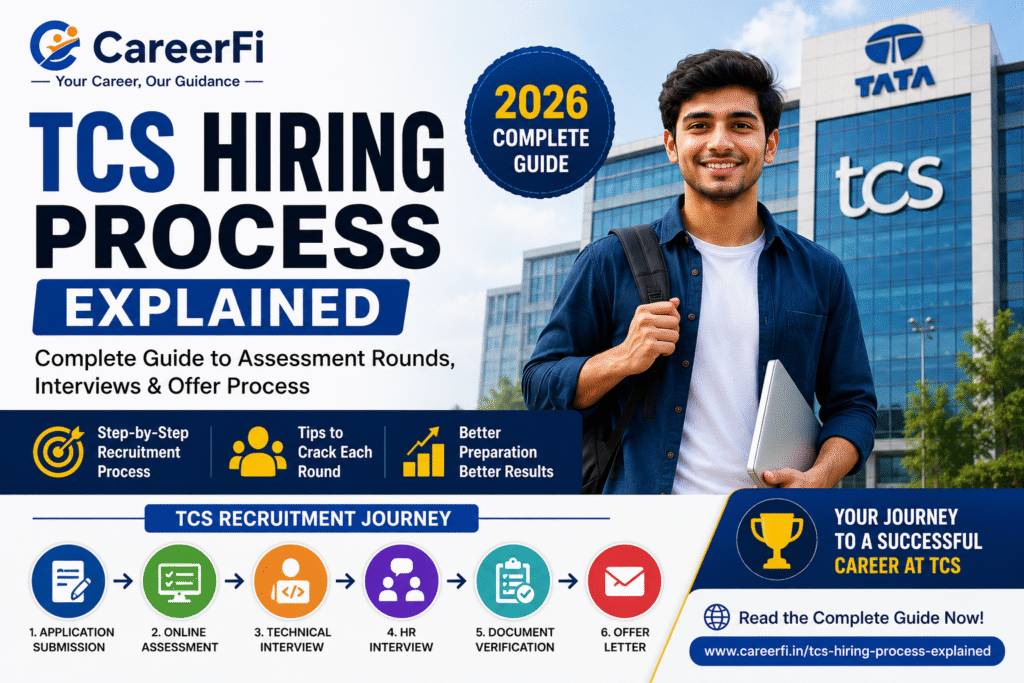
Overview of the TCS Hiring Process
The recruitment journey generally follows these stages:
- Application Submission
- Online Assessment
- Technical Interview
- HR Interview
- Document Verification
- Offer Letter
Stage 1: Application Submission
Everything starts with the application process. Candidates can apply through the TCS careers portal, TCS NQT registration, campus placement cells, or off-campus recruitment drives.
What Recruiters Check
- Academic performance
- Degree eligibility
- Graduation year
- Resume quality
- Skills and certifications
Tips for This Stage
- Keep your profile updated
- Use a professional email address
- Upload a clean resume
- Highlight projects and certifications
- Avoid incorrect information
A strong profile increases the chances of getting shortlisted.
Stage 2: Online Assessment Round
The online assessment is one of the most important stages of the recruitment process. Many candidates are eliminated at this stage.
Purpose of the Assessment
The assessment evaluates aptitude, analytical thinking, communication, programming ability, and problem-solving skills.
Section 1: Verbal Ability
This section tests reading comprehension, grammar, vocabulary, and sentence correction.
- Read English articles daily
- Improve vocabulary
- Practice comprehension exercises
Section 2: Quantitative Aptitude
Topics often include percentages, profit and loss, time and work, speed and distance, probability, permutations, and combinations.
- Learn shortcuts
- Practice regularly
- Focus on speed and accuracy
Section 3: Logical Reasoning
Questions may include number series, puzzles, coding-decoding, data interpretation, and pattern recognition. Logical reasoning helps recruiters evaluate analytical skills.
Section 4: Programming Logic
Candidates are tested on basic algorithms, flowcharts, and logical programming concepts. Even non-coders should understand fundamental programming logic.
Section 5: Coding Test
For technical roles, coding questions may be included.
Stage 3: Technical Interview
Candidates who clear the assessment move to the technical interview round. This stage evaluates practical knowledge and problem-solving ability.
Common Technical Topics
Programming Languages
- Difference between OOP and procedural programming
- Inheritance
- Polymorphism
- Exception handling
Database Management
- SQL queries
- Joins
- Normalization
- Primary and foreign keys
Operating Systems and Networks
- Process management
- Scheduling and deadlock
- TCP/IP and DNS
- HTTP vs HTTPS and OSI model
Project-Based Questions
One of the most important parts of the interview is discussing your projects. Typical questions include:
- Explain your project.
- What challenges did you face?
- What technologies did you use?
- What was your role?
Candidates who understand their projects deeply generally perform better.
Stage 4: HR Interview
The HR interview focuses on personality, communication, and cultural fit. This round is often underestimated.
Common HR Questions
Tell Me About Yourself
Your answer should include education, skills, projects, and career goals.
Why Do You Want to Join TCS?
Good answers focus on learning opportunities, global projects, career growth, and strong reputation.
Are You Comfortable Relocating?
TCS operates in multiple cities, so candidates are usually expected to be flexible.
Strengths and Weaknesses
For strengths, examples can include problem solving, communication, adaptability, and teamwork. For weaknesses, choose genuine areas for improvement and explain how you are working on them.
Stage 5: Document Verification
After successful interviews, document verification is conducted. Documents typically include:
- Academic certificates
- Government ID proof
- Resume
- Passport photographs
- Internship certificates
- Category certificates, if applicable
Ensure all information matches the details provided during registration.
Stage 6: Offer Letter Process
Candidates who successfully clear all rounds receive an offer letter. The offer generally includes designation, compensation details, joining location, terms, and conditions.
What Happens After Receiving the Offer?
- Accept the offer
- Complete onboarding formalities
- Submit required documents
- Participate in training programs
The joining timeline can vary depending on business requirements.
Benefits of Clearing the TCS Recruitment Process
Structured Training Programs
Freshers receive training before working on live projects.
Strong Learning Environment
Employees gain exposure to new technologies, industry best practices, and global projects.
Career Stability
TCS is known for providing long-term career opportunities.
Global Exposure
Many employees work with international clients and teams.
Continuous Upskilling
The company encourages learning through certifications and internal training platforms.
Preparation Tips to Crack the TCS Hiring Process
Start Early
Begin preparation at least three to six months before recruitment season.
Focus on Aptitude
Aptitude remains one of the most important elimination stages. Practice daily.
Strengthen Coding Skills
Even basic programming proficiency can improve performance significantly.
Build Strong Projects
Projects make a major difference during interviews. Focus on real-world applications, problem-solving, and practical implementation.
Take Mock Tests
Mock tests help identify weaknesses and improve confidence.
Improve Communication Skills
Clear communication can positively impact both technical and HR interviews.
Frequently Asked Questions
Is TCS hiring difficult?
The process is competitive but achievable with consistent preparation.
Does TCS ask coding questions?
Yes, depending on the role and hiring program.
How many interview rounds are conducted?
Typically one technical and one HR interview, though the process may vary.
What is the most important round?
The online assessment is often the biggest elimination stage.
How long does it take to receive an offer letter?
The timeline varies depending on the recruitment cycle and business requirements.
Can non-engineering students apply?
Yes, certain hiring programs are open to candidates from different educational backgrounds.
Conclusion
The TCS hiring process is designed to identify candidates who possess strong technical knowledge, analytical thinking, communication skills, and a willingness to learn.
While the recruitment journey may seem challenging at first, understanding each stage can significantly improve your chances of success.
From the online assessment and technical interview to HR discussions and final onboarding, every stage offers an opportunity to showcase your skills and potential.
The key is to prepare systematically, stay confident, and continuously improve your knowledge and communication abilities.
With the right strategy and consistent effort, securing a career at TCS can become an achievable goal and a strong foundation for your professional journey.