
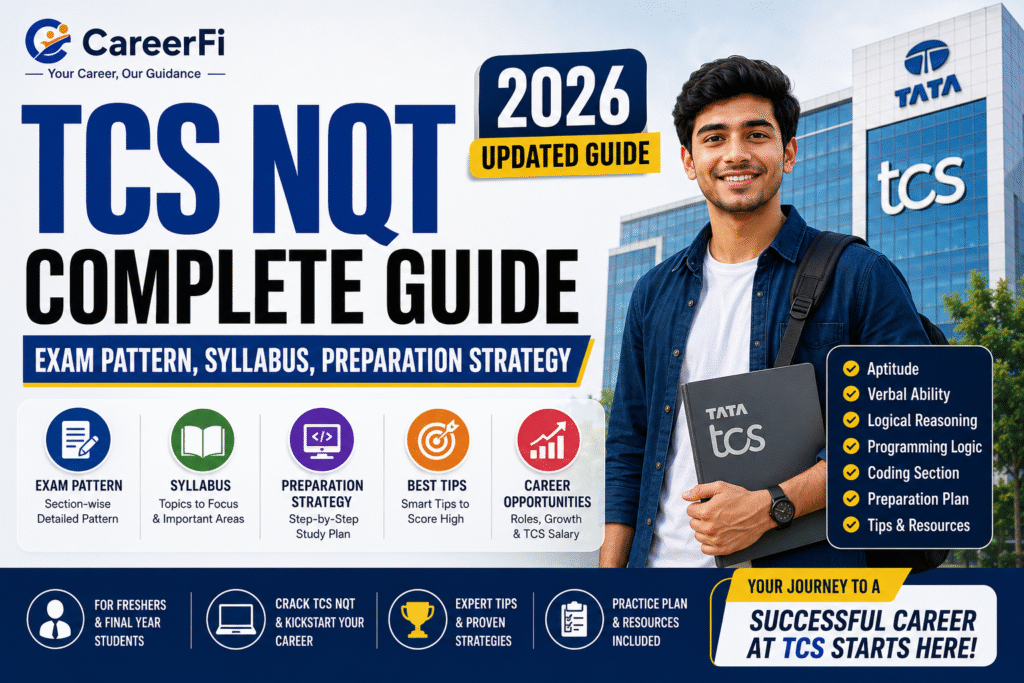
CareerFi Placement Guide • Updated for 2026
TCS NQT Complete Guide 2026: Exam Pattern, Syllabus, Eligibility, Preparation Plan and Career Opportunities
Preparing for TCS NQT in 2026? This detailed guide explains what TCS NQT is, who can apply, the latest test pattern, important syllabus topics, preparation strategy, common mistakes, interview tips and FAQs for students aiming for TCS Ninja, Digital and Prime opportunities.
TCS NQT 2026 Overview
TCS National Qualifier Test, commonly called TCS NQT, is one of the most searched fresher hiring assessments in India. For engineering and technology students, it often becomes a serious pathway to start a career with Tata Consultancy Services, especially through profiles such as TCS Ninja, TCS Digital and TCS Prime.
Every placement season, students search for questions like "What is TCS NQT?", "Is TCS NQT difficult?", "What is the TCS NQT syllabus?", "How many months are required for TCS NQT preparation?" and "Can I get a TCS job through NQT?" This guide answers those questions in a practical, student-friendly way.
SEO summary: TCS NQT 2026 is an integrated fresher hiring test with Foundation and Advanced sections. Your performance can help you qualify for interviews under TCS Prime, Digital or Ninja categories, subject to official eligibility and hiring requirements.
What is TCS NQT?
TCS NQT stands for Tata Consultancy Services National Qualifier Test. It is an assessment used to evaluate a candidate’s employability skills such as numerical ability, verbal ability, reasoning ability, advanced problem solving and coding. In simple words, it checks whether a fresher is ready for entry-level professional roles in technology and business environments.
For many students, TCS NQT is valuable because it gives them a structured way to prove their skills beyond college marks. A strong test performance can improve your chances of receiving an interview opportunity in the relevant TCS hiring category.
Reasoning
Verbal Ability
Advanced Quant
Coding
Why TCS NQT matters for freshers
- It gives students an off-campus or all-India hiring route beyond college placement drives.
- It tests skills that are also useful for other company placement exams.
- It encourages students to prepare aptitude, communication and coding together.
- It can help shortlisted candidates move toward TCS interview rounds.
TCS NQT Exam Pattern 2026
According to the official TCS All India NQT Hiring 2026 page, the test is an integrated assessment conducted at TCS iON centers. It contains a Foundation section and an Advanced section. All candidates are encouraged to attempt both sections, while the Advanced section is especially important for candidates targeting Digital or Prime opportunities.
| Section | Sub-section | Duration | What it checks |
|---|---|---|---|
| Part A: Foundation | Numerical Ability | 25 minutes | Basic quantitative aptitude, calculations and mathematical reasoning |
| Part A: Foundation | Verbal Ability | 25 minutes | English grammar, comprehension, vocabulary and communication readiness |
| Part A: Foundation | Reasoning Ability | 25 minutes | Logical thinking, pattern recognition and analytical problem solving |
| Part B: Advanced | Advanced Quantitative and Reasoning Ability | 25 minutes | Higher-level problem solving for stronger technical profiles |
| Part B: Advanced | Advanced Coding | 90 minutes | Programming, algorithms, debugging and code implementation |
| Total | Integrated test | 190 minutes | Overall fresher job readiness |
Because the TCS NQT pattern can be updated across hiring cycles, candidates should check the official TCS announcement before registration. For the 2026 All India NQT Hiring page, TCS states that test performance can qualify candidates for Prime, Digital or Ninja interviews.
TCS NQT Syllabus 2026: Section-Wise Topics
The TCS NQT syllabus is not about memorizing one fixed question bank. It is about building speed, accuracy and logical thinking across repeated placement exam topics. Below is a practical syllabus map for preparation.
1. Numerical Ability
This section tests your comfort with numbers and formulas. Students who practice consistently can score well because many topics follow repeatable patterns.
- Number system, HCF and LCM
- Percentages, ratio and proportion
- Profit and loss, simple and compound interest
- Time and work, pipes and cisterns
- Time, speed and distance
- Averages, mixtures and allegations
- Probability, permutation and combination
- Basic geometry and mensuration
2. Verbal Ability
Verbal Ability is important because TCS and other IT companies look for candidates who can communicate clearly with teams, clients and managers.
- Reading comprehension
- Grammar and sentence correction
- Vocabulary, synonyms and antonyms
- Para-jumbles and sentence arrangement
- Fill in the blanks
- Business communication basics
3. Reasoning Ability
Reasoning questions reward pattern recognition and calm thinking under time pressure. Daily practice is the best way to improve.
- Coding-decoding
- Number series and letter series
- Blood relations
- Directions and distances
- Seating arrangement
- Syllogisms and logical statements
- Data interpretation and data sufficiency
4. Advanced Quantitative and Reasoning Ability
The Advanced section is usually tougher than the Foundation section. Candidates targeting Digital or Prime should practice higher-difficulty aptitude and reasoning questions instead of stopping at basic formulas.
- Complex data interpretation
- Advanced arithmetic applications
- Logical puzzles with multiple conditions
- Higher-level probability and combinatorics
- Multi-step reasoning problems
5. Advanced Coding
Coding is the section where many candidates either stand out or lose momentum. Pick one programming language and become comfortable with input-output handling, loops, arrays, strings and common algorithms.
- Arrays and strings
- Loops, functions and recursion
- Searching and sorting
- Basic data structures
- Pattern-based logic problems
- Edge cases and debugging
- Time complexity basics
TCS NQT Eligibility 2026
Eligibility depends on the specific TCS hiring notification. For the TCS All India NQT Hiring 2026 page, TCS mentioned 2024, 2025 and 2026 batches with qualifications such as B.Tech, B.E., M.Tech, M.E., MCA and M.Sc. Candidates should read the full official notification because academic percentage, backlogs, gap rules, work experience and branch requirements may vary.
Common candidate groups
- Final-year engineering students
- Recent graduates
- Early career candidates with limited experience
- Postgraduates in eligible technical streams
Skills recruiters value
- Logical thinking
- Clear communication
- Programming fundamentals
- Problem-solving confidence
- Learning mindset
Before applying: Do not rely only on old videos, screenshots or unofficial social media posts. Check the official registration page and read the eligibility section line by line.
TCS Ninja vs Digital vs Prime: What Should You Target?
Students often hear about Ninja, Digital and Prime but do not understand how to plan preparation around them. These are interview or offer categories linked to performance and business requirements. The exact outcome depends on test score, interview performance, eligibility and available opportunities.
TCS Ninja
Usually considered the broad entry-level fresher category. Focus on strong Foundation performance, basic coding, communication and interview readiness.
TCS Digital
Generally targets candidates with stronger coding, problem solving and technical understanding. Advanced section preparation becomes important.
TCS Prime
Typically associated with higher performance expectations. Candidates should aim for advanced coding strength and confident technical interviews.
If you are confused about which category to target, prepare for the highest level your timeline allows. A candidate who prepares seriously for Digital or Prime usually becomes stronger for Foundation-level questions as well.
Best TCS NQT Preparation Strategy for 2026
The best TCS NQT preparation strategy is not to study randomly. You need a plan that balances aptitude, reasoning, verbal ability and coding. Below is a focused six-week roadmap that works well for many students.
Week 1-2: Build the foundation
- Revise formulas for percentages, profit and loss, time and work, ratios and averages.
- Practice grammar basics, reading comprehension and vocabulary for 30 minutes daily.
- Solve easy reasoning questions to understand common patterns.
- Choose one coding language such as Python, Java, C++ or C.
Week 3-4: Increase speed and accuracy
- Start topic-wise timed practice for aptitude and reasoning.
- Solve coding problems on arrays, strings, loops and functions.
- Track mistakes in a notebook and revise them every two days.
- Attempt short mock tests instead of only reading theory.
Week 5: Advanced practice
- Practice advanced quantitative and reasoning sets.
- Solve medium-level coding questions with edge cases.
- Analyze weak areas section by section.
- Prepare short explanations for your projects and technical skills.
Week 6: Mock tests and revision
- Attempt full-length mock tests in a test-like environment.
- Revise formulas, grammar rules and coding templates.
- Focus on time management and question selection.
- Sleep properly before the exam and keep documents ready.
Daily Study Timetable for TCS NQT
If you can study 4 to 5 hours daily, use a balanced timetable. If you have college classes, reduce the time but keep the order consistent.
| Activity | Recommended Time | Goal |
|---|---|---|
| Quantitative Aptitude | 60 minutes | Improve formulas, speed and accuracy |
| Reasoning Ability | 45-60 minutes | Build pattern recognition and logic |
| Coding | 90 minutes | Practice implementation and edge cases |
| English | 30 minutes | Improve grammar, reading and vocabulary |
| Mock analysis | 30 minutes | Review errors and update revision notes |
TCS NQT Coding Preparation Tips
For coding, do not jump straight into difficult dynamic programming problems if your basics are weak. TCS NQT coding preparation should begin with implementation confidence.
- Master input and output format in your chosen language.
- Practice arrays and strings until you can solve basic questions without hints.
- Learn how to dry-run code on paper.
- Test your solution with small, large and edge-case inputs.
- Understand sorting, searching and basic recursion.
- Write clean code with meaningful variable names.
Smart practice: After solving a question, rewrite the same solution once without looking. This builds exam-time confidence faster than passive watching.
What Happens After TCS NQT?
Based on test performance and hiring requirements, eligible candidates may receive interview opportunities. The interview can include technical questions, project discussion, programming basics, HR questions and communication evaluation.
Common interview preparation areas
- Resume explanation
- Final-year project or internship work
- Programming language fundamentals
- OOP concepts such as class, object, inheritance and polymorphism
- DBMS, SQL and basic computer science concepts
- HR questions such as strengths, weaknesses and relocation preference
Do not wait for the result to start interview preparation. After your exam, revise your resume and practice explaining your projects clearly in two minutes.
Common Mistakes Students Make in TCS NQT Preparation
Many students do not fail because they are incapable. They fail because their preparation is scattered. Avoid these mistakes if you want a serious chance.
- Ignoring aptitude: Coding is important, but Foundation sections can decide whether you stay in the race.
- Only watching videos: Concepts are useful only when you solve questions yourself.
- No mock analysis: Mock tests without analysis only measure your score; they do not improve it.
- Weak basics in coding: If arrays, strings and loops are unclear, advanced questions become stressful.
- Last-minute English preparation: Verbal ability improves with daily reading and grammar practice.
- Depending on rumors: Always verify official dates, eligibility and instructions from TCS.
Best Resources for TCS NQT Preparation
You do not need too many resources. You need the right mix of concept learning, practice questions, coding problems and mock tests.
For aptitude and reasoning
- Standard quantitative aptitude books
- Topic-wise practice sets
- Timed quizzes
- Mock test platforms
For coding and interviews
- Beginner-friendly programming tutorials
- Arrays and strings practice sets
- SQL and DBMS revision notes
- Mock interview practice
For official updates, visit the TCS All India NQT Hiring page.
Frequently Asked Questions About TCS NQT 2026
Is TCS NQT difficult?
TCS NQT is usually moderate for candidates who prepare consistently. The difficulty increases if you ignore timed practice, coding basics or mock test analysis.
Can I get a job in TCS through NQT?
TCS NQT is an important hiring pathway. Based on eligibility, test performance and business requirements, candidates may qualify for interviews for TCS hiring categories.
How many weeks are required for TCS NQT preparation?
Many students can build a strong base in 6 to 8 weeks with consistent preparation. Candidates with weak coding or aptitude basics may need more time.
Which language is best for TCS NQT coding?
Choose the language you know best. Python, Java, C++ and C are common choices. Your logic, implementation and edge-case handling matter more than the language name.
Is the Advanced section mandatory?
For the 2026 All India NQT Hiring page, TCS says all candidates are encouraged to attempt both sections, and the Advanced section is mandatory if you aspire for Digital or Prime offers.
What is the total duration of TCS NQT 2026?
The official TCS All India NQT Hiring 2026 pattern lists a total duration of 190 minutes for the integrated test.
Are non-engineering students eligible for TCS NQT?
Eligibility depends on the specific hiring notification. Read the official TCS page carefully because qualifications and batches can vary by drive.
Final Thoughts: How to Crack TCS NQT 2026
TCS NQT is not just another exam. For many freshers, it is a structured opportunity to show job readiness, strengthen placement preparation and compete for roles in one of India’s largest IT companies. The students who perform well are usually not the ones who study randomly at the last minute. They are the ones who understand the pattern, build fundamentals, practice daily and analyze mistakes honestly.
If your goal is TCS Ninja, Digital or Prime, start with the Foundation section but do not stop there. Improve coding, strengthen advanced problem solving, revise your resume and prepare for interviews early. A disciplined six-week plan can change your placement confidence completely.
Stay connected with CareerFi
For fresher job updates, placement guides, resume tips and interview preparation resources, follow CareerFi on WhatsApp, LinkedIn and Instagram.